When to Retire Your Running Shoes
Where the 300–500 mile rule comes from, the wear signs that matter more, what changes shoe lifespan, how to track miles, and what to do with old pairs.
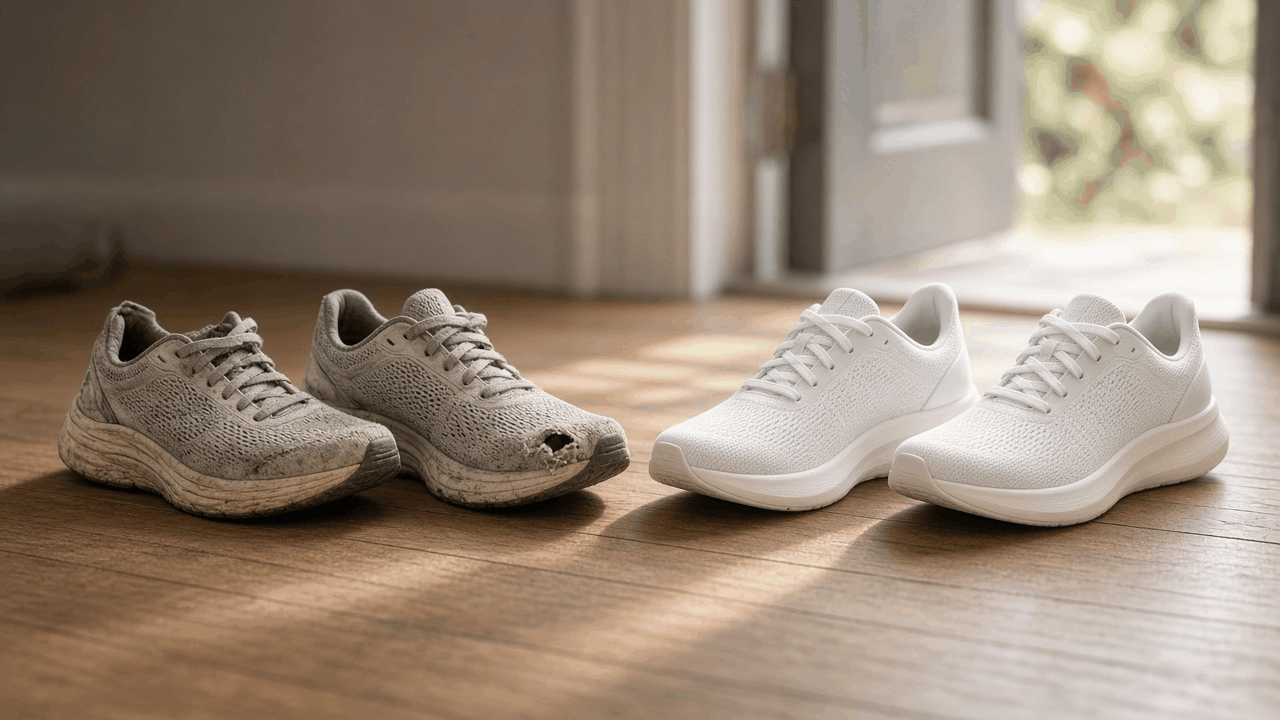
Running shoes don't come with an expiry date. Most runners go by one number instead: replace them every 300 to 500 miles. That range is a fair starting point, but the real answer depends on your mileage, what the shoe looks like, and how your legs feel.
Where the 300–500 mile rule comes from
The range traces back largely to one 1985 study. Cook, Kester, and Brunet tested running shoes on a machine that simulated repeated heel strikes. The shoes kept about 75% of their original shock absorption after 50 simulated miles, about 67% after 100–150 miles, and less than 60% between 250 and 500 miles (Cook et al., 1985). Shoes worn by real runners lost cushioning too, but more slowly. They kept about 70% at 500 miles.
Podiatry groups echo the range. The American Academy of Podiatric Sports Medicine says midsoles should be considered worn out after 300–500 miles of running or walking (AAPSM). Another AAPSM page puts a typical running shoe at 350–500 miles (AAPSM). The American Podiatric Medical Association currently lists 600–800 miles of running or walking, or every 6–8 months (APMA). So even the experts give different numbers.
Later studies with real runners found smaller changes than the machine did. In one study of EVA-midsole shoes worn for 500 km (about 310 miles), peak impact force went up by about 5% on average (Wang et al., 2010). Another found a 16–33% drop in heel cushioning after 480 km (about 300 miles) in runners who land on their heels (Cornwall & McPoil, 2017).
Treat the range as the point where you start inspecting, not as a deadline.
Wear signs that matter more than the odometer
- Midsole creasing and compression. Deep wrinkles in the foam, mostly along the sides, are a sign it has compressed. AAPSM lists "noticeable creasing" and a shoe that sits unevenly on a flat surface as signs the midsole is worn out (AAPSM). Set the shoes on a table and look at them from behind. Do they lean?
- Outsole wear-through. When the rubber has worn down to the foam underneath, it's time. AAPSM also flags a heel that has worn more than 4 mm lower on one side than the other (AAPSM).
- Heel counter and upper breakdown. The heel counter is the firm cup around your heel. AAPSM treats it as broken down when it feels floppy when you squeeze it side to side, or when it visibly tilts to one side from behind (AAPSM).
- A shoe that feels flat. This one is real but unreliable. In Cornwall and McPoil's study, runners did not notice the loss of heel cushioning even after 640 km (about 400 miles), even though the lab measured it (Cornwall & McPoil, 2017). If a shoe does feel dead, take that seriously. But "it still feels fine" does not prove the foam is fine.
- New aches. Coaches often tell runners to watch for feeling more sore or beat up after runs in a particular pair (CTS). If a new ache shows up only in one pair, that pair is a suspect. Still, check your training load first.
What makes shoes last longer or shorter
- Shoe type. A CTS coach notes that cushioned daily trainers have traditionally lasted longer than low-stack shoes, while carbon-plated "super shoes" appear to wear faster despite their thick foam (CTS). That is a coaching observation, not a controlled finding.
- Runner weight and stride. AAPSM advises heavier runners and hard heel strikers to replace shoes toward the lower end, around 350 miles (AAPSM).
- Surface. Terrain changes where a shoe wears. Smooth trails and pavement tend to wear the sole in one consistent pattern. Technical trails spread the sole wear out but can wear out the upper faster. Trail shoes worn on pavement wear down faster, and so do road shoes taken on rough singletrack (CTS).
- Foam type. All midsole foams compress over time, but not at the same rate. In a lab test of five commercial midsole foams, every one lost cushioning and rebound under repeated compression, and how fast it happened depended on the foam's structure (Aimar et al., 2024). In a separate study, a PEBA-foam racing shoe lost its running-economy advantage over an EVA version after 450 km (about 280 miles) of wear. The EVA shoe barely changed (Rodrigo-Carranza et al., 2024).
The takeaway: your racing shoes and your daily trainers probably won't retire at the same mileage.
Track your miles
A rough count is enough. Pick one method and stick with it:
- Watch and app gear tracking. COROS lets you add shoes, enter a starting mileage, and set a maximum distance with an alert (COROS). Strava tracks miles per pair, and you can set a mileage notification on its website. The default alert is 250 miles and can be raised to 800 (Strava gear; Strava notifications). Garmin Connect has a similar gear tracking feature for shoes (Garmin).
- A simple log. Write the date you started using the pair on the tongue or insole with a marker, and keep a running total in a note on your phone or a spreadsheet.
When a pair hits your alert, inspect it. Don't automatically throw it out.
Rotate two pairs (with honest expectations)
A 22-week study of 264 recreational runners found that runners who used more than one pair of shoes during the same period had a 39% lower injury hazard than single-pair runners (hazard ratio 0.614) (Malisoux et al., 2015). That is encouraging, but it was observational. Runners chose whether to rotate shoes, so people who own several pairs may also differ in other ways, like experience or how carefully they train.
The broader evidence linking old shoes to injury is weak. A 2021 systematic review found high-quality evidence that running shoe age was not a risk factor for running injuries (van Poppel et al., 2021).
A common belief is that a shoe needs a day off for the foam to "recover." In Cook's 1985 tests, resting shoes for 24–48 hours changed shock absorption by less than 3% (CTS, quoting Cook et al.). Two pairs mostly spread wear across both and give your legs slightly different shoes to run in.
A practical setup: one daily trainer plus a broadly similar second pair. Bring the new pair in while the old one still has some miles left, so you're never forced into a sudden switch.
What to do with old shoes
- Walking or yard shoes, with care. Retired pairs work fine for mowing, gardening, or errands. Be cautious about heavy walking mileage, though. A CTS coach describes an athlete whose IT band flared up after daily dog walks in badly compressed retired running shoes (CTS).
- Donate wearable pairs. Programs such as Soles4Souls accept new or gently worn shoes, running shoes included, as long as they are still wearable (Soles4Souls).
- Recycle the rest. Shoes worn past donation can often go to a local textile or shoe recycler or a retailer take-back bin. Clean them first and follow the program's rules (Soles4Souls).
Takeaway checklist
- Log miles per pair in your watch app or a simple note
- Start inspecting around 250–300 miles; don't wait for 500
- Check for creases, a lean on a flat table, worn-through rubber, and a floppy heel counter
- Take a "dead" feel seriously, but don't count on noticing it
- Look for new aches that show up in one pair only, and check your training load first
- Expect racing and super shoes to wear out sooner than daily trainers
- Rotate two pairs if your budget allows. It may help, but it isn't a guarantee
- Donate wearable pairs and recycle the rest
Sources
- Cook SD, Kester MA, Brunet ME. Shock absorption characteristics of running shoes. Am J Sports Med. 1985;13(4):248–253. https://pubmed.ncbi.nlm.nih.gov/4025676/ (DOI: https://doi.org/10.1177/036354658501300406)
- American Academy of Podiatric Sports Medicine. How do I know when it is time to replace my athletic shoes? https://www.aapsm.org/replace_shoes.html
- American Academy of Podiatric Sports Medicine. When is the right time to replace your shoes? https://www.aapsm.org/replace-shoes.html
- American Podiatric Medical Association. Choosing shoes for sports. https://www.apma.org/patients-and-the-public/tips-for-healthy-feet/choosing-shoes-for-sports/
- Wang L, Li JX, Hong Y, Zhou JH. Changes in heel cushioning characteristics of running shoes with running mileage. Footwear Science. 2010;2(3). https://doi.org/10.1080/19424280.2010.519348
- Cornwall MW, McPoil TG. Can runners perceive changes in heel cushioning as the shoe ages with increased mileage? Int J Sports Phys Ther. 2017;12(4):616–624. https://pubmed.ncbi.nlm.nih.gov/28900568/
- Aimar A, et al. Compression fatigue of elastomeric foams used in midsoles of running shoes. Footwear Science. 2024. https://doi.org/10.1080/19424280.2024.2317881
- Rodrigo-Carranza V, et al. Influence of different midsole foam in advanced footwear technology use on running economy and biomechanics in trained runners. Scand J Med Sci Sports. 2024. https://pubmed.ncbi.nlm.nih.gov/37858294/ (DOI: https://doi.org/10.1111/sms.14526)
- Malisoux L, et al. Can parallel use of different running shoes decrease running-related injury risk? Scand J Med Sci Sports. 2015;25(1):110–115. https://pubmed.ncbi.nlm.nih.gov/24286345/ (DOI: https://doi.org/10.1111/sms.12154)
- van Poppel D, et al. Risk factors for overuse injuries in short- and long-distance running: A systematic review. J Sport Health Sci. 2021;10(1):14–28. https://doi.org/10.1016/j.jshs.2020.06.006
- Anderson R (CTS). When to replace trail running shoes. https://trainright.com/replace-trail-running-shoes/
- COROS Help Center. Gear Tracking. https://support.coros.com/hc/en-us/articles/30206047249556-Gear-Tracking
- Strava Help Center. How do I add gear to my activities on Strava? https://support.strava.com/en-us/articles/15402143-how-do-i-add-gear-to-my-activities-on-strava
- Strava Help Center. How do I manage shoe mileage notifications on Strava? https://support.strava.com/en-us/articles/15401878-how-do-i-manage-shoe-mileage-notifications-on-strava
- Garmin Support. Gear Tracking feature in Garmin Connect. https://support.garmin.com/en-US/?faq=9EtB5L0OA26gp56Yv9tyH9
- Soles4Souls. Donate shoes. https://soles4souls.org/give-shoes/
- Soles4Souls. What to do with old shoes? https://soles4souls.org/what-to-do-with-old-shoes/