Stay Seen, Stay Alert as Days Get Shorter
Tips for recreational runners as evenings get darker earlier — be seen, see the ground, pick safer routes, stay aware, and know when to run indoors or at lunch.
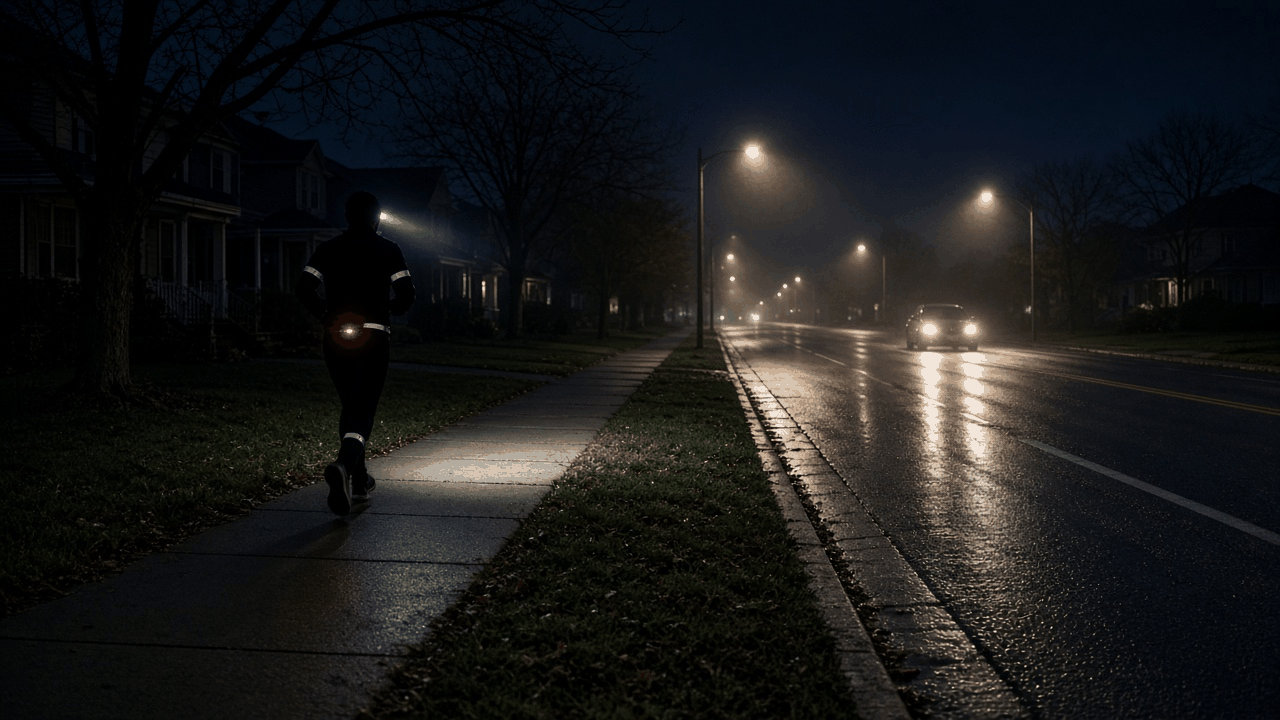
Most of the United States fell back an hour on Sunday, November 1. So this Monday evening is darker earlier than last week — and that shift sticks for months.
You do not need a new identity as a “night runner.” You need a short list of habits that keep you visible, aware, and on your feet when daylight leaves before dinner.
Why darkness changes the risk
In 2024, more U.S. pedestrian traffic fatalities happened in the dark (76%) than in daylight (20%), dusk (2%), or dawn (2%), according to NHTSA’s Traffic Safety Facts (Pedestrians: 2024 data, DOT HS 813 818). That figure covers all pedestrians on foot — walkers and runners — not runners alone. Still, it is a clear signal: low light is when being seen matters most.
Your job is simple. Help drivers notice you sooner. Help yourself see the ground. Reduce surprise.
1. Be visible: lights plus reflective on moving parts
Dark clothing disappears against pavement and hedges. Drivers often do not recognize a person until late.
Closed-road research found the same pattern: with low beams and black clothing (especially with glare), drivers rarely recognized pedestrians; with retroreflective markings arranged to show biological motion — markers on limbs that move as you run — recognition jumped and distances got much longer (Wood, Tyrrell & Carberry, 2005, Human Factors; DOI 10.1518/001872005774859980). Follow-up work keeps finding that ankle (and wrist) markers plus a vest beat a torso vest alone (Balk et al., open-road study abstract).
Practical kit that matches that idea:
- A light drivers can see — clip-on or vest light facing traffic, not only a lamp aimed at your toes
- Reflective on ankles, wrists, or moving straps — motion is easier to read than a flat chest panel
- A vest or sash — useful, but do not stop there; add limb reflectors if you can
NHTSA’s own pedestrian reminders say the same basics: be visible at night with reflective materials or a light, and never assume a driver sees you (Pedestrians: 2024 data — Important Safety Reminders).
2. See the ground: headlamp vs chest light
Being seen and seeing are different jobs.
- Headlamp: points where you look; good for reading the path, curbs, and roots. Bounce can bother other runners if the beam is high and bright.
- Chest or waist light: steadier beam while you look around; often nicer for road shoulders. Can cast more shadow from arms and torso on uneven trails.
If you only own one light, aim it so you can plant each foot safely and so something bright faces approaching cars. Test your setup on a familiar block before you trust a new route.
3. Pick the route for darkness, not just distance
Daylight routes and dark routes are not the same loop.
Prefer:
- Sidewalks or shared paths with street lighting
- Familiar pavement without surprise construction
- Fewer driveway cut-throughs and left turns across traffic
- Neighborhoods where you already know the odd curb and loose dog
Avoid stacking hard miles on a brand-new shoulder the first week of standard time. Save exploration for daylight.
4. No sidewalk? Face traffic
NHTSA’s pedestrian safety reminders: use a sidewalk or path when one exists; if none is available, walk on the shoulder facing traffic, stay alert, and do not assume drivers see you (same NHTSA fact sheet reminders).
For runners on a road shoulder, that still means: face oncoming cars so you can step off early, give yourself space, and make yourself obvious. Local laws can vary — when a sidewalk exists, use it.
5. Tell someone, and share where you are
Before you leave, send a short note: route, expected time back, and who to call if you go quiet.
Phone options most people already have:
- Live location sharing for the duration of the run
- An emergency contact set up in your phone’s safety features
- A watch or phone that can auto-alert if you fall (if you use that feature, test it once at home)
You are not being dramatic. You are closing the gap between “I’m out” and “someone knows where to look.”
6. Headphones and staying aware
Music is fine. Tuning out the street is not.
Keep volume low enough to hear engines, bikes, and voices. Prefer one open ear, bone-conduction, or speakers at a quiet level on busy roads. At crossings, pause the track and look both ways — including for quiet EVs.
If a car approaches from behind on a shared road, assume they have not locked onto you until their path clearly shows it.
7. Footing: slow down in the dark
Darkness hides ice glaze, wet leaves, potholes, and uneven seams. Easy effort can still mean a slower pace than your usual daytime shuffle.
Shorten your stride a little. Land softer. Treat the first mile of a dark route as reconnaissance, not a time trial. A rolled ankle costs more training than a few slow minutes.
8. Shift the run when the evening slot gets sketchy
Some weeks the honest move is not more gear — it is a different clock.
- Lunch run on a lit campus or neighborhood loop
- Treadmill or indoor track for the easy day
- Early morning if that window is brighter and calmer where you live
You still get the miles. You skip the worst visibility window. That is training judgment, not quitting.
9. Group runs help — without rewriting your whole plan
A partner or small group means more lights, more eyes, and someone who notices if you fade. Use groups for the glue miles; keep key workouts wherever your plan already works.
If you want a local starting point, Pace Kit’s Run Club Finder lists clubs you can filter by day and vibe — useful when you would rather not invent a dark route alone.
A short evening checklist
Before you head out after dusk:
- Forward light for the ground + something bright facing traffic
- Reflective on moving parts (ankles/wrists), not only a dark top
- Familiar, lit route; sidewalk if you have one
- Facing traffic on any shoulder stretch
- Someone knows your route and when you should be back
- Volume low enough to hear the street
- Pace willing to go slower for footing
Darker evenings are a season, not a crisis. Stack a few of these habits and keep training without gambling on being seen.