When Fall Race Weather Still Feels Like Summer
September and October races can still throw heat and humidity. Here’s how to adjust goals the week of without rewriting your whole training block.
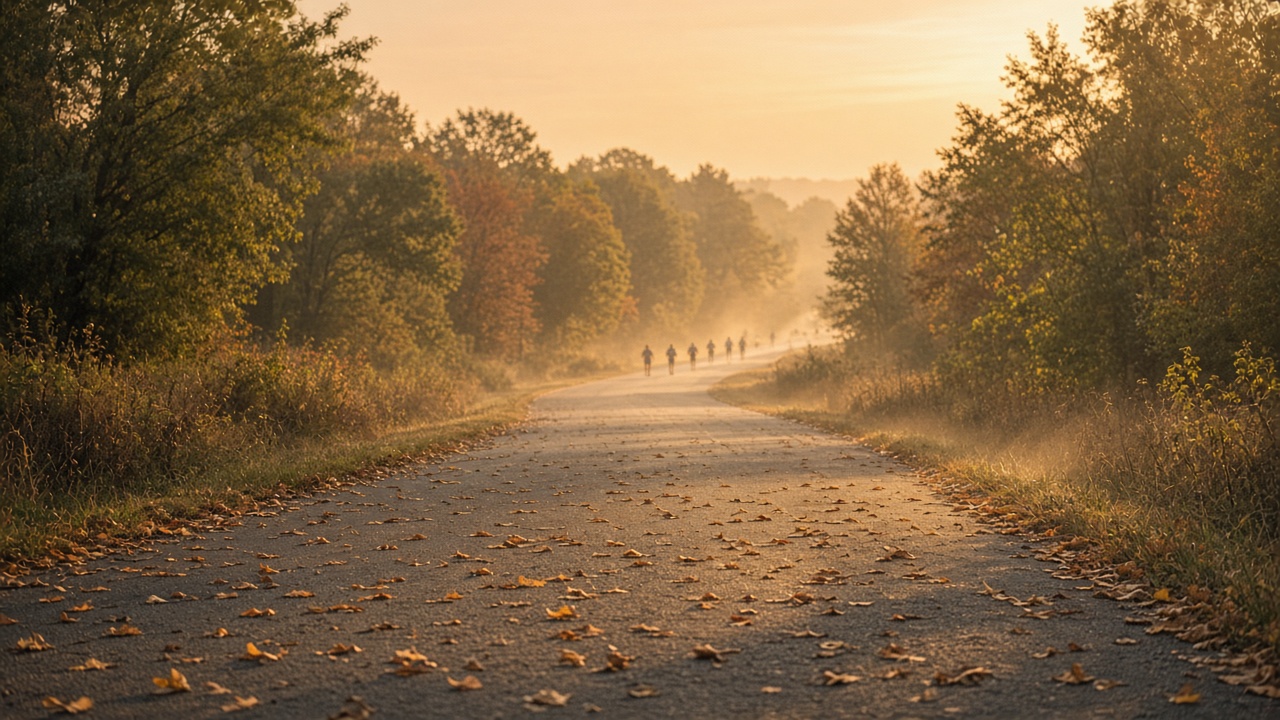
The calendar says fall. The start list says fall. Your weather app may still say August.
A lot of September and October races land in that awkward window where mornings look “cooler than summer” on paper and still feel sticky once you’re 20 minutes into the race. If you trained through heat all summer, you already know the trap: treating a slightly lower number on the forecast as permission to race like it’s 50°F and dry.
You don’t need a new training plan. You need a race-week filter.
1. Check the whole race window, not the start-line screenshot
If you’re out there for an hour or more, conditions at mile 1 and mile 8 can be different problems. Look at:
- Temperature trend after the gun
- Humidity / dew point feel (this is often the real limiter)
- Sun exposure on the course, not just air temp
- Wind that helps or cooks you depending on direction
A 7:30 a.m. start that climbs into sun and humidity is a different race than a short, shady cooler hour.
Event organizers often lean on Wet Bulb Globe Temperature (WBGT) — a combined read of heat, humidity, sun, and wind — when deciding whether to modify or stop a race. Consensus sports-medicine guidance popularized by ACSM treats roughly 30.1°C WBGT as a participation cut-off for non-acclimatized / higher-risk athletes and about 32.3°C WBGT for acclimatized, fit, lower-risk athletes (Consensus Recommendations on Training and Competing in the Heat). You don’t need to run the math yourself; the point is: if the race weekend already feels “summer,” treat the forecast as a plan input, not a vibe check.
2. Prefer effort goals when the air is heavy
On warm, humid days, pace is a lagging indicator. Heart rate and perceived effort climb first. Keep the race’s purpose — finish strong, even splits, negative second half, “run my plan” — and let the clock float if the day demands it.
Useful reframes:
- Time goal → “same effort as my cool-weather goal pace”
- PR day → “best execution day for these conditions”
- Workout-as-race → shorter hard segments, longer recoveries, or move the hard work to a cooler slot earlier in the week
Finishing cooked because you refused to adjust isn’t toughness. It’s a longer recovery.
Practical dew-point heuristic (not a lab formula): coaching guides often treat dew point as the humidity number that matters. A common runner-facing table: little impact below about 55°F dew point; start taking hard sessions seriously in the 60–65°F band; expect noticeably slower paces around 65–70°F; and above roughly 70°F dew point, favor effort over pace targets entirely (Runners Connect dew-point pace guide). Individual response varies with acclimatization, duration, and sun load — use it as a starting point, not a law.
A separate coaching rule of thumb you’ll hear: add on the order of 20–30 seconds per mile for every ~5°F above ~60°F air temperature (Runner’s World heat-and-pace overview). Again: heuristic, not a personal guarantee.
3. Race-week swaps that actually help
- Start more conservative than your cool-weather plan for the first 10–20%
- Respect fluid and fuel needs earlier than you think (heat raises cost even when the race isn’t “that long”)
- Don’t introduce new shoes, new gels, or a hero session midweek to “make up” for heat nerves
- If the forecast is ugly, decide early: effort day, adjusted time goal, or treadmill/backup long run — not at mile 4
For fluid ranges on hot days, see our earlier post How to Pick a Safer Window for Hot Runs (ACSM / NFHS cited there).
4. Use a structured read when the forecast is fuzzy
If you want a clearer pass at heat risk, pace adjustment, and cooler windows for your ZIP and duration (no defaults baked into this article), Pace Kit’s Heat Run Advisor is built for that. Plug in where you’ll race and how long you’ll be out, then decide whether this is a push day, an execution day, or a protect-the-next-block day.
Fall racing is still racing. The weather just doesn’t always get the memo.